Time Travel Movies

How the Best Films Change the Past

If Doc Brown taught us anything, it's that messing with the past is a bad idea. Of course, if Marty McFly had listened to him, Back to the Future would've been a very short movie.
That's the fun of time travel movies. Send somebody into the past, let them change one little thing, then stand back and watch the trouble begin.
Except that's not how every time travel movie works.
Some movies let their characters rewrite history. Others insist that history can't be changed at all. Some create alternate timelines. And a few tie themselves into such elaborate knots that figuring out what happened is half the fun.
As a screenwriter, what interests me isn't really the time machine. It's what the writer decides happens after somebody uses it.
What Happens When You Change the Past in a Time Travel Movie?
There isn't one answer. That's probably the first thing anyone discovers after watching a few time travel movies. The rules in one film can completely contradict the rules in another.
Change something in the past in Back to the Future and you can rewrite your own present.
Try it in 12 Monkeys and you're out of luck. What happened, happened.
Avengers: Endgame finds another solution. Change something in the past and you don't rewrite your own history. You create a different timeline.
Which one is scientifically correct? I'm a screenwriter, not a theoretical physicist. I'm staying well away from that argument.
For a movie, there's a more important question: Which rule creates the best story?
BACK TO THE FUTURE: What If You Accidentally Change Your Own Past?
Few movies have had more fun with cause and effect than Back to the Future.
Marty McFly travels from 1985 to 1955 and accidentally prevents his parents from falling in love. The result isn't an interesting philosophical discussion about temporal mechanics. Marty starts disappearing.
That's wonderfully simple storytelling.
Marty has changed the event that eventually produced Marty. If he doesn't repair the damage, he won't exist. But Back to the Future goes further than simply giving Marty something to fix. When he returns to 1985, his actions in 1955 have improved his family's lives. George is confident and successful. Lorraine is happier. Biff is no longer tormenting George.
Marty hasn't just returned home. He's returned to a different version of home.
And that's one of the great pleasures of this kind of time travel story. Change the past and we get to discover the consequences along with the character.
Then The Terminator comes along and makes everything more complicated.
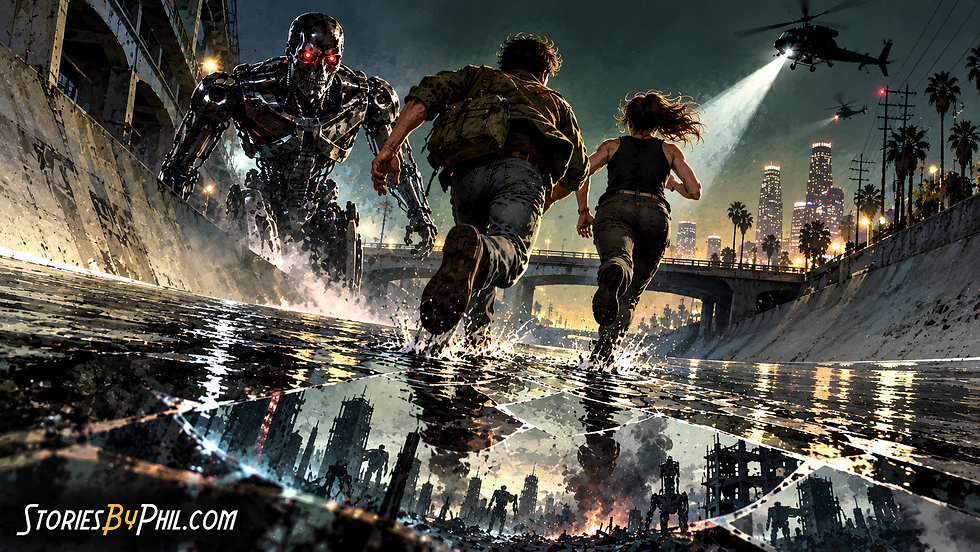
THE TERMINATOR: What If Changing the Past Causes the Future?
The machines send a Terminator from 2029 to 1984 to kill Sarah Connor before she can give birth to John Connor, the future leader of the human resistance. John sends Kyle Reese back to protect her.
Straightforward enough.
Until Kyle becomes John's father. Think about that for a moment. John Connor exists because Kyle Reese travels back in time. But Kyle travels back in time because John Connor sends him. So which came first?
Exactly.
This is one reason The Terminator remains such a satisfying time travel story. The time travel isn't just a delivery system that gets a killer robot into 1984. It becomes part of the dramatic machinery of the story itself.
The future creates the past that creates the future.
Try drawing that family tree.
12 MONKEYS: What If You Can't Change the Past?
Most time travel heroes head into the past believing they can do something about it.
James Cole in 12 Monkeys has a more depressing problem.
Humanity has been devastated by a virus. Cole is sent from the future into the 1990s to gather information that might help scientists develop a cure.
At first, the movie feels as though it might be heading toward the familiar objective: discover what's going to happen and prevent it. But 12 Monkeys operates under a crueler rule. The past has already happened.
Cole isn't travelling into an unfinished version of history. He's travelling into his own history.
That distinction gives the movie much of its power. The closer Cole gets to understanding events, the closer he gets to realizing his place within them. Time travel doesn't give him control over history. It reveals how little control he ever had.
That's a very different dramatic use of exactly the same device.

THE BUTTERFLY EFFECT: What If Every Solution Creates Another Problem?
If Back to the Future makes changing history look dangerous, The Butterfly Effect practically hangs a sign over the past saying: DO NOT TOUCH.
Evan discovers that he can revisit traumatic moments from his childhood and change what happened. Naturally, he tries to make things better.
Bad idea.
Every correction changes his present, often catastrophically. One altered event can leave him living an entirely different life. The movie keeps returning him to new realities produced by his attempts to repair previous ones.
And that's what makes the premise work.
Evan isn't travelling through time because he wants to see dinosaurs or find out who really built Stonehenge. He's trying to fix things. That's painfully human.
We've probably all wondered what would happen if we could go back and change one decision, prevent one mistake or say something we should have said.
The Butterfly Effect answers: You might want to leave well enough alone.
LOOPER: What Happens When You Meet Your Future Self?
Here's another problem I hope never comes up.
What if somebody sends your future self back through time and tells you to kill them?
That's Joe's predicament in Looper.
In 2044, Joe works as an assassin killing people sent back from the future by criminals who want them disposed of. Eventually a looper's own older self is sent back to be killed, thereby “closing the loop.”
Then Joe's future self arrives. And escapes.
What I particularly like about Looper is that time travel turns an internal character conflict into a literal one. Young Joe and Old Joe are the same man. But they don't want the same thing. Old Joe has lived another thirty years. He has loved, lost and acquired motivations his younger self doesn't yet understand.
So who gets to decide their future? The young man who hasn't lived it yet? Or the older man desperately trying to preserve the life he remembers?
Suddenly “meeting your future self” isn't just a clever sci-fi gimmick. It's conflict.
And conflict is story.
AVENGERS: ENDGAME: What If Changing the Past Creates Another Timeline?
By the time Avengers: Endgame arrived, audiences had seen enough time travel movies that the filmmakers could actually have some fun arguing with them.
The Avengers can't simply travel into their past, change events and expect their own present to transform accordingly. Their actions create branching timelines rather than rewriting the history they came from.
It's a useful solution to a problem that hangs over almost every time travel movie:
If the heroes go back and prevent the disaster that caused them to travel through time, why would they ever need to travel through time to prevent it? And if they don't travel back, doesn't the disaster happen again?
Welcome to time travel.
Endgame effectively sidesteps that problem by separating the traveller's original history from the new consequences created by interfering with earlier events.
Same basic storytelling device. Different rules. And therefore completely different possibilities.
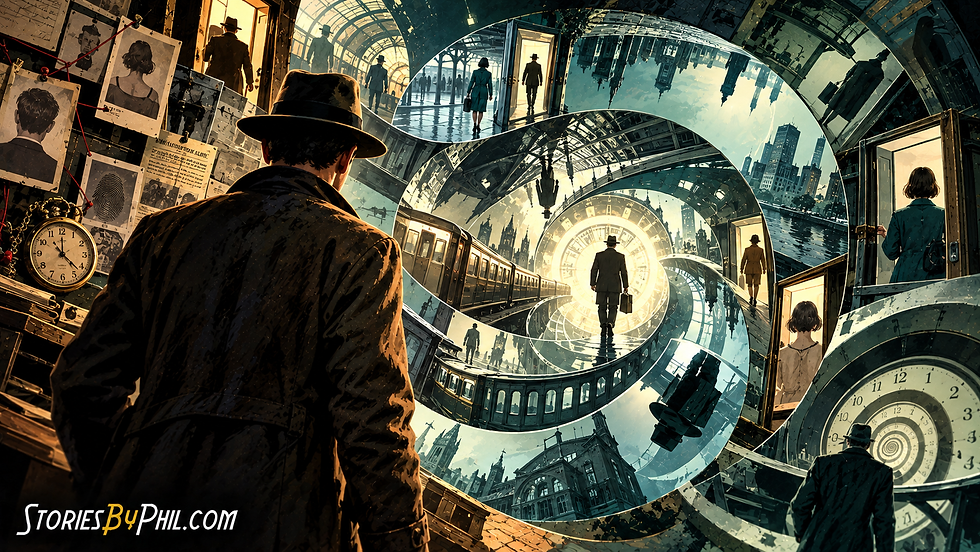
PREDESTINATION: How Complicated Can a Time Travel Movie Get?
Pretty complicated, as it turns out.
There are time travel movies that use the device to launch an adventure.
Then there's Predestination.
The basic premise is deceptively simple: a Temporal Agent undertakes a series of journeys through time and, on his final assignment, must recruit his younger self while pursuing a criminal who has continually escaped him.
“Recruit his younger self” barely scratches the surface.
The movie takes the idea that a person can become entangled in their own history and pushes it about as far as I can imagine pushing it. Characters become causes of events that shaped their own lives. Identities fold back upon themselves. Origins become effects and effects become origins.
At a certain point, asking “But where did it all start?” becomes the point. Maybe it didn't.
Which brings us into the territory of time travel paradoxes, something I'll tackle separately because otherwise this article may disappear into a temporal vortex of its own.
Why Do Time Travel Movies Keep Sending People Into the Past?
Because the past gives a writer something the future doesn't.
Consequences the audience already understands.
If somebody travels 500 years into the future and knocks over a coffee cup, we have no idea whether it matters.
Send Marty McFly into the past and stop his parents from meeting? Uh-oh.
Send somebody back to kill the mother of a future resistance leader? We immediately understand what's at stake.
Let somebody revisit a childhood trauma and change what happened? We want to know what their life looks like when they return.
When a character knows something the people around them don't - what's supposed to happen next - that creates suspense almost automatically.
Will history happen the way they remember it? Can they stop it? Should they stop it? And what else might they change while trying?
That's why I think the most interesting question in a time travel movie usually isn't:
How did they travel through time?
It's: What are they going to do now that they're there?
Can You Really Change the Past in a Time Travel Movie?
Apparently, that depends which movie you bought a ticket to see.
Back to the Future says yes.
The Butterfly Effect says yes, but you'll probably regret it.
12 Monkeys says no.
The Terminator ties cause and effect together in a loop.
Avengers: Endgame says you can change events, but that doesn't mean you're rewriting the history you came from.
Looper puts past and future versions of one person into direct conflict.
Predestination looks at all of this and says, “Hold my beer.”
None of these approaches is automatically better than another. What matters is that the movie establishes rules that create compelling consequences. Because without consequences, time travel is just transportation.
And nobody remembers Back to the Future because the DeLorean got good mileage.
Time Travel Turns the Past Into a Battleground
That's the idea that particularly interests me.
A character who knows the future has something nobody else in the past possesses: information.
They know who lives. Who dies. What succeeds. What fails. Maybe even how the world ends. Suddenly the past isn't history anymore. It's something that can be fought over.
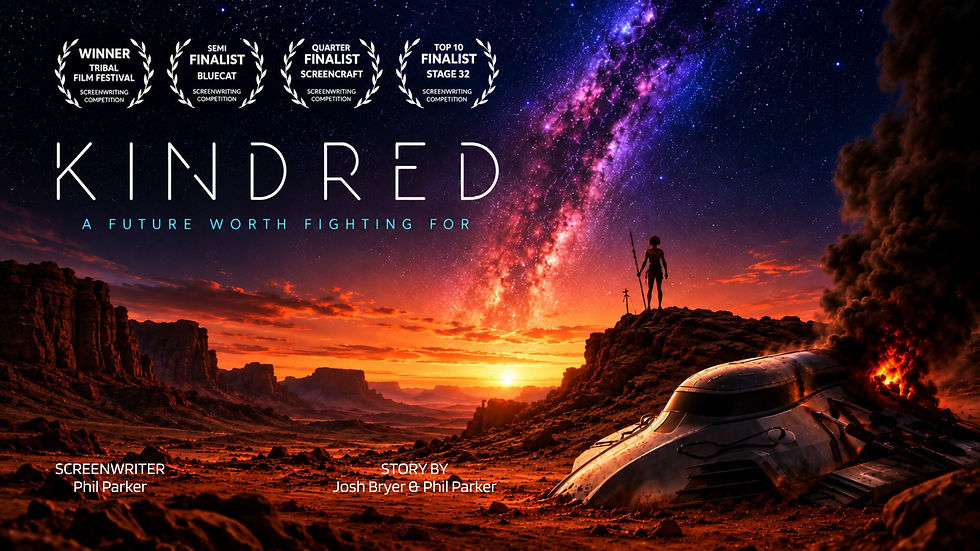
That's the territory I explored while working on KINDRED, a time-travel action/adventure screenplay I was hired to rewrite from an original story by Josh Bryer.
In KINDRED, a man who refuses to face his past is visited by his future daughter with a desperate warning: confront the people who tormented him as a child before they kill him and enslave the world.
The screenplay takes one of my favourite ideas in time travel movies and turns it into an action story:
What if somebody from the future knew exactly what had to change, but changing it meant confronting something in the past you'd spent your whole life trying to escape?
That's when time travel becomes more than a science-fiction device.
It becomes personal.
Explore KINDRED, a time-travel action/adventure screenplay by Phil Parker.

